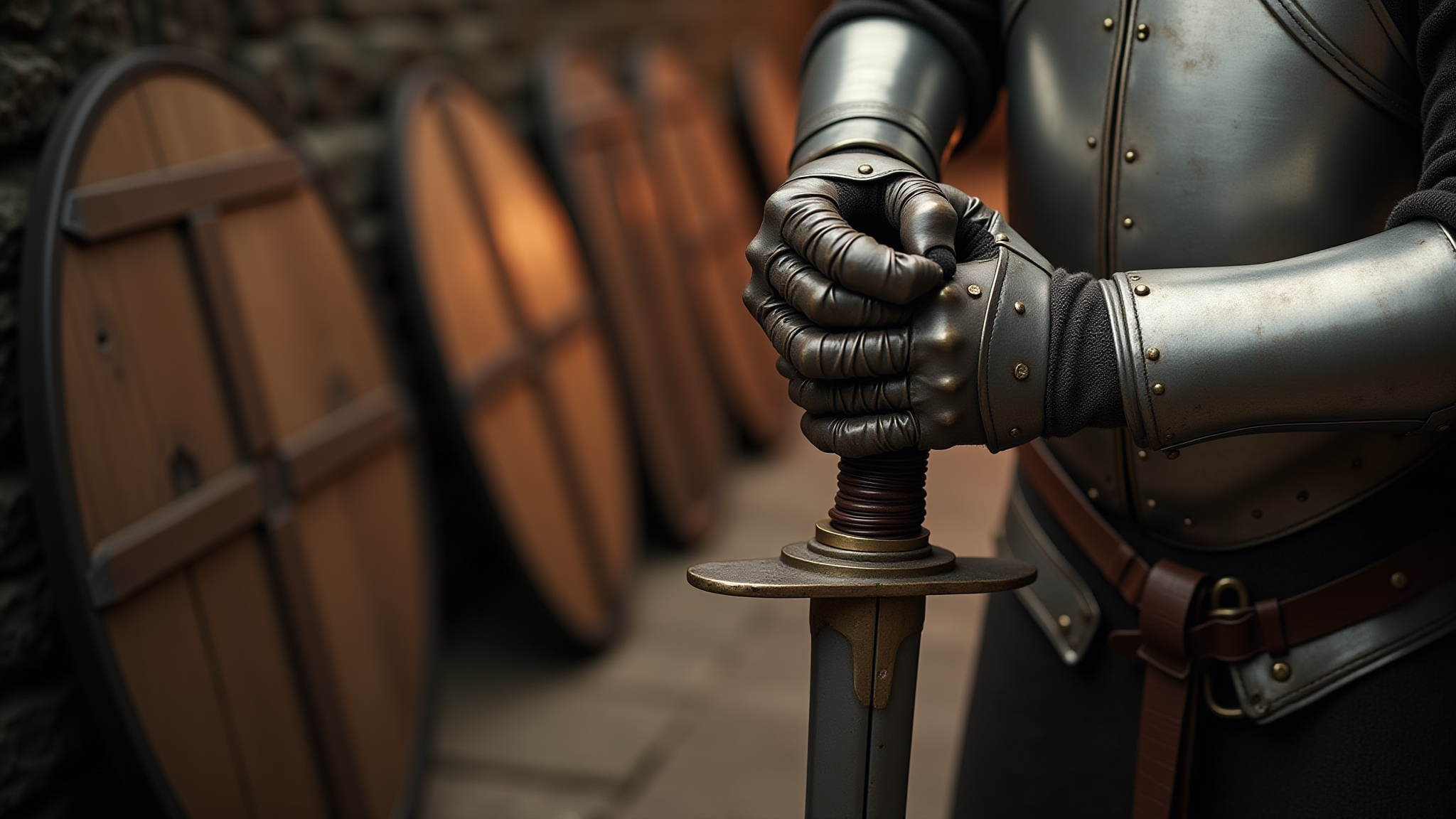
A Tradition of Chivalry.
Knight Errant Academy of Chivalry teaches historical European martial arts through Oplomachia, our complete system of medieval combat.
Students learn real martial skills drawn from the fighting traditions of medieval Europe: swordsmanship, empty-hand combat, dagger, shield, spear, pole weapons, grappling, and eventually armored combat.
But learning how to fight is only half of our purpose.
We believe martial skill carries responsibility.
That is why the physical study of combat is taught alongside the virtues of chivalry: Courage, Justice, Honor, Fidelity, Prowess, Honesty, and Humility.
What we teach physically is violence.
What we teach philosophically is chivalry.
The goal is not simply to create capable fighters.
It is to develop people worthy of the skills they have been given.
Dragon Slayers | Ages 5–7
Every knight has to begin somewhere.
Dragon Slayers introduces our youngest students to martial arts through movement, coordination, purposeful games, medieval adventure, and age-appropriate challenges.
They learn to listen, move with control, work safely with others, and discover the satisfaction of overcoming something difficult.
They may think they’re learning how to fight dragons.
We know they’re building the foundation for everything that follows.
Explore Dragon Slayers →
Order of the Page - Ages 8–12
This is where the formal study of swordsmanship begins.
Pages learn the foundations of Oplomachia through the Hand-and-a-Half sword, footwork, Measure, empty-hand skills, games, drills, controlled sparring, and tournament combat.
As their skills grow, so does the responsibility placed upon them.
They learn that control matters more than strength, that an opponent is a problem to understand rather than simply overcome, and that honor matters most when choosing it costs you something.
Explore the Order of the Page →
Order of the Squire - Ages 13–16
Skill begins to become judgment.
Squires build upon their foundation with increasingly sophisticated weapons, techniques, tactics, and combat problems.
Students are expected to take greater responsibility for their training, understand why techniques work, recognize opportunities for themselves, and demonstrate the character expected of a developing martial artist.
The question is no longer simply, “Can you perform the technique?”
It becomes, “Do you understand when and why to use it?”
Explore the Order of the Squire →
Order of Arms - Ages 16 + Up
The complete study of Oplomachia.
The Order of Arms follows a progression from Novice through Master at Arms, developing proficiency across the weapons, principles, and methods of the system.
Students study swordsmanship, dagger, shield, pole weapons, striking, wrestling, grappling, half-swording, armored techniques, tactical decision-making, and the deeper principles of Measure.
At the highest levels, technical skill alone is no longer enough.
Students are expected to demonstrate judgment, character, leadership, and eventually the ability to pass the art to others.
Explore the Order of Arms →
Chivalry Must Be Practiced
We can tell a student that Honor matters.
Eventually, we have to give them an opportunity to prove it.
In Oplomachia tournament combat, the fighter receiving a valid blow is responsible for acknowledging it.
The marshal controls the field and protects the fighters, but once combat begins, victory cannot simply be claimed.
It must be granted by your opponent.
That means a student may someday face a difficult choice:
Nobody else saw the blow.
Do I call it anyway?
That moment teaches more about Honesty and Honor than a lecture ever could.
This is what we mean by teaching chivalry.
Not something to memorize.
Something to practice.
Serious Training Should Still Be Fun
Our students work hard.
They also laugh.
They play games. They fight tournaments. They hit training targets. They solve problems. They make friends. They occasionally discover that the instructor’s carefully planned lesson is apparently less interesting than whatever ridiculous name the class has just given a drill.
That’s okay.
Enjoyment and serious training are not opposites.
For younger students especially, play is one of the ways difficult physical and tactical concepts become understandable.
Behind the game is the lesson.
Behind the lesson is the martial art.
And sometimes the student doesn’t realize how much they have learned until the game becomes a fight and the answer is already there.
Begin Your Journey
You do not need previous martial arts experience.
You do not need to know anything about medieval history.
And you certainly do not need to already know how to use a sword.
You only need somewhere to begin.
For our youngest students, that might mean learning to stand, listen, move, and face their first imaginary dragon.
For another student, it may mean holding a sword for the first time.
Years later, that same student may be standing across from an opponent, teaching someone else, earning the rank of Master at Arms, or perhaps becoming worthy of something greater.
Every one of those journeys begins the same way.
With the first lesson.
Train Hard and Be Knightly.